The Terror That Started It All
My first trip abroad thirty years ago and the changes it wrought
My sixty-fifth birthday is a day for reflection. It’s a big milestone for me, and my life has become one large planned event covering all the places I want to visit as fast as I can see them. The list is long. To give you an idea, I have six trips to five countries on three continents between now and October.
I have often reflected on how I got here, with this traveling life that straddles the Atlantic Ocean split between two major cities. It began with my first trip overseas to Izmir, Türkiye.1
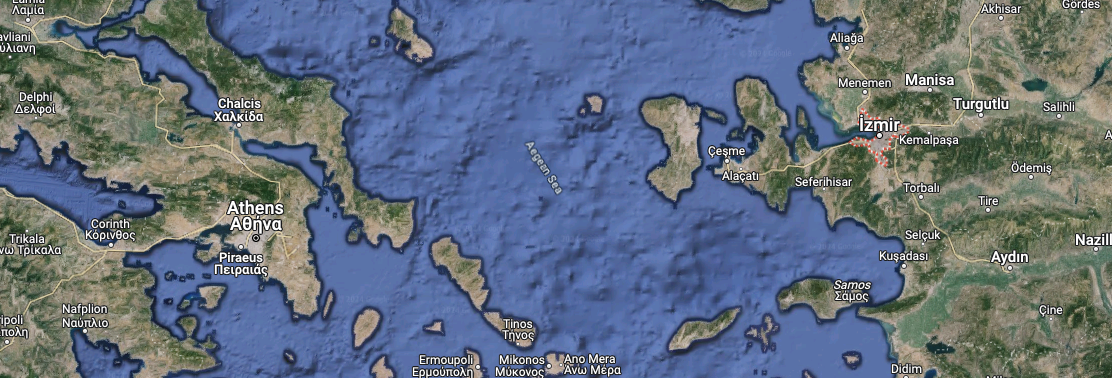
On the map, Izmir is located directly across the Aegean Sea from Athens, Greece. While the city is ancient, the modern upgrade was based on the city plan for Tampa, Florida. The similarities have faded somewhat, but over thirty years ago, having spent many summers in Tampa, I was surprised how much the two cities were alike, especially along the bay.
In early August 1990, the USAF cargo plane carried me to what Google Maps calls the Izmir Air Force Base (now permanently closed), two days before Sadam Hussein invaded Kuwait, which eventually kicked off the Gulf War.
This was my first trip overseas, my first passport, my first real adventure in life. Married less than a year, other than two suitcases, my things remained in storage in the U.S. My precious golden retriever was rehomed to our vet and his family, which included two young boys and a swimming pool, aka “dog heaven.” I told my parents goodbye and headed to the Air Force base in Charleston.
Why were we on a military cargo plane, you ask? I have no idea. I did not know it was unusual, but I learned later from the others stationed in Izmir that they arrived by standard Delta economy class.
I never intended to go overseas. I was clerking for Chief Justice Hornsby in Alabama when I met my future husband. Although my position was only for a year, I interviewed and accepted another position with Justice Earnest Finney in South Carolina for the next two years. Justice Finney was not yet the Chief Justice but was well on his way. He was the first African-American appointed to the South Carolina Supreme Court since Reconstruction. He was fascinating, and I could not wait to work for him.
But it didn’t happen.
When he learned that my new military husband had been assigned to Izmir, he revoked my position and told me that I needed to follow my spouse to Turkey. He said living overseas, specifically in Turkey, would be a lifetime experience I should not miss. Justice Finney is no longer with us, but if he were, I would visit him and tell him how much he changed my life in that fifteen-minute meeting where I thought my world, or at least my law career, was ending.
Landing at what was then a joint-use Turkish military airbase outside the city, my husband’s superior officer drove us into the city on a mid-week night at 2:00 a.m. The car was old and creaky, painted that ugly green that only the military uses. The road, a brand-new freeway, had no lines on the asphalt. The traffic meandered wherever the drivers wanted, and I held my breath several times at the close calls.
I learned that lines on the highway were a new thing in Türkiye then. Not long after I arrived, I also learned that Turks learning how to drive in the country were not taught by driving schools. It was more of an “on-the-job” training or learning-as-you-go.
There was no room at the inn. Seriously. The military orders had us living at the U.S. Kordon Hotel, but we were dropped at a small local hotel. Our military hotel room would be ready for our two-week stay in a few days. I crashed with jet lag but was awakened several hours later by the call to prayer. It began before sunrise over the mosque’s loudspeaker behind the hotel.
That evening, I opened the curtains on the second floor and watched the busy street below. Izmir sits on the Aegean Sea, ten hours by car south of Istanbul. It is at the end of a large bay across the sea from Greece.2 That first evening, I saw very few women in the street, mostly men in suit jackets, pants that may or may not match, and black pointy leather loafers. The men spent evenings at the coffee shops on the bayside walkway. They would chat and smoke after dinner and play backgammon.
I wanted to go out, but the absence of women made me nervous. That first evening, my little Southern self was too frightened of this unfamiliar world, and no amount of reading about it made me ready to take that first step. I ate an apple from my backpack for dinner, too scared to go outside, even with my husband.
The next morning, I needed to venture out, regardless. I was hungry, and my husband was already at work. The American cafeteria was in the Kordon Hotel a block away, and if I wanted to eat, I had to leave my room.3 It took me an hour to talk myself into venturing outside.
But once I did…
Here’s a section of one of the drafts of my novel, The Expedient Wife, left on the cutting room floor. This will give you an idea of what I saw that first week.
Breathing in the sea air slowly and deeply, I gained control; I could do this.
Palm trees planted in large irregular holes in the sidewalk looked like future personal injury hazards. The city looked like Miami or Tampa circa 1950 or maybe Cuba. Intricately carved stone buildings and a massive white marble seaside walkway stretched for blocks. I scrutinized the city around me. Women pushed baby strollers next to the sea wall, and young couples sat on benches. An open cafe across the street smelled of grilled meats and french fries. People were everywhere, enjoying the outdoors, enjoying their life. A calmness settled over me. They were just normal people.
I walked several blocks, and the sun and light breeze were a comforting change from the claustrophobic hotel. Yet after a few blocks, I felt naked from the blatant ogles of the older men and the scornful stares from the older women. I knew this was a different world, but I didn’t understand until now. My T-shirt and jeans weren’t enough to cover me for their satisfaction, even though the locals my age wore the same clothing.
Well, no. Not exactly. The girls wore jackets over their T-shirts and socks with their shoes. It was those little things that the military instructions had missed.
A rough-hewn wooden cart clattered by with mounds of grapes in varying hues and sizes on its flatbed. A grizzled farmer pushed the cart, and I had to smile as he winked and grinned. A gypsy cart in pinks and blues with noisy wheels and a clopping shaggy pony rattled by, brass bells strung along its sides. Three women with long braids and flowered headscarves sat in the back. A small child clung to the leg of the male driver in front.
Another handcart rolled by with green pears stacked in a pyramid, then a third with a wide variety of garden vegetables, salad greens, and an old brass scale that clanged with each cobblestone. As each vendor passed, they smiled or nodded. Several stopped and offered me samples. One man stopped and offered me a deep purple fig the size of a tangerine, pulling it apart, his hand extended with half.
I hesitated. The Air Force flyer in our welcome package heavily discouraged eating food from street vendors. I had been shocked at the list of foods Americans were discouraged from eating and all the rules of living in Izmir. One insisted all food be soaked in bleach before eating. Everything. We were told not to drink the milk because it was not pasteurized.
I took the fig. Biting into the explosive sweetness, the list of rules be damned. The man, delighted with my reaction, gave me the other half of the fig. He demanded only a smile in payment and refused my offer of American money.
Winding through the tree-lined streets, the neighborhood was a mixture of residential and commercial, with small mom-and-pop stores on the ground level and family apartments up top. I longed to see inside the apartments of one building as I spied a lush garden on the top floor.
Laundry hung from lines extended across the small side balconies of the apartments, with ladies’ “unmentionables” flapping in the sea breeze. The auto traffic was lighter away from the bay, and pedestrians dominated the streets. There were groups of shoppers, women with strollers and men in suits strolling arm in arm, smoking cigarettes. Two men in front of me stopped at the intersection and, like a French movie, grabbed each others’ shoulders, kissed each other on both cheeks, then laughed and waved goodbye.
After that first day, I was enchanted with Turkey. Each time I stepped outside that hotel door, my silly fears were erased. I roamed the city, hunting for an apartment, exploring the ancient Kemeraltı market for shopping, and finding the best greengrocers for fresh produce.
I went on several excursions, got lost many times (those will be in future posts), and met new people. Unfortunately, the photos from that period did not survive. You’ll have to see the photos in the links above and below.
Thus began my fascination with traveling, particularly in Turkey. I’ll begin writing about places in Istanbul in detail in July and invite you to come along. But take my advice if you visit: do not eat an entire box of baklava in one sitting, no matter how delicious.
That is a lot of sugar.4
As of June 2022, the correct spelling is Türkiye, and after the advertisements, the link tells you why. The word has no “American” or “English” version. ↩
To learn the history of much of Türkiye, reading Lisa Morrow’s articles and books will be a great start. Lisa is an Australian-born sociologist and author and has lived in Turkey for thirteen years. Her byline has appeared in the New York Times, the Guardian UK, BBC Travel, World Nomads, Fodors, and Hyperallergic. She is the author of five books about Türkiye. ↩
I learned later that many military wives had been told before leaving the States to bring a small suitcase with American food, that the Turkish food was “inedible” and the milk and cheese “unpasteurized.” I didn’t get that memo, and I am glad I didn’t begin my new life that way. ↩
If you are interested in reading travel information about Izmir, this blog post from Novo-Monde, updated in January 2024, is a good place to start. Another by Lonely Planet is also trustworthy. Remember that travel is a personal experience. Your mileage may vary. ↩